
Which Plinko Version Are You Actually Looking At?
Before comparing maximum multipliers or RTP percentages, you must identify the exact game version. The BGaming original Plinko carries a 99% published RTP and a 1,000× maximum multiplier, while Hacksaw Gaming’s version offers configurable RTP variants ranging from 88.20% to 98.98% and a maximum of 3843.3×. Meanwhile, 1X2gaming’s Plinko GO lists RTP variants of 96%, 94%, or 92% with a 420× cap. These are not interchangeable specifications; an operator may select a lower RTP variant without changing the game’s visible name.
Our version identifier tool asks you to check the provider logo, the help-file URL, and the paytable range. If the rules page references bgaming-network.com and shows 8–16 lines with Low/Normal/High risk, you are likely looking at the BGaming original. If the paytable displays a 3843.3× maximum or mentions Hacksaw Gaming, the mathematics differ significantly. Do not assume that a game called simply Plinko at LeoVegas matches the BGaming demo; LeoVegas lists a Gaming Corps edition with 8, 10, 12, 14, or 16 rows and 1, 2, 3, 5, or 10 balls per drop.
Sources: BGaming original Plinko product page · Hacksaw Plinko · 1X2 Network Plinko GO (Branded) · LeoVegas Plinko by Gaming Corps
What the BGaming Demo Controls Actually Change
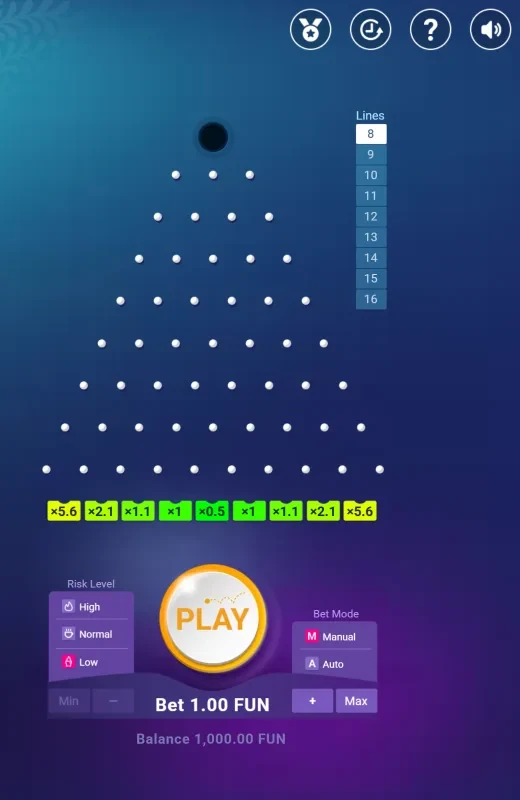
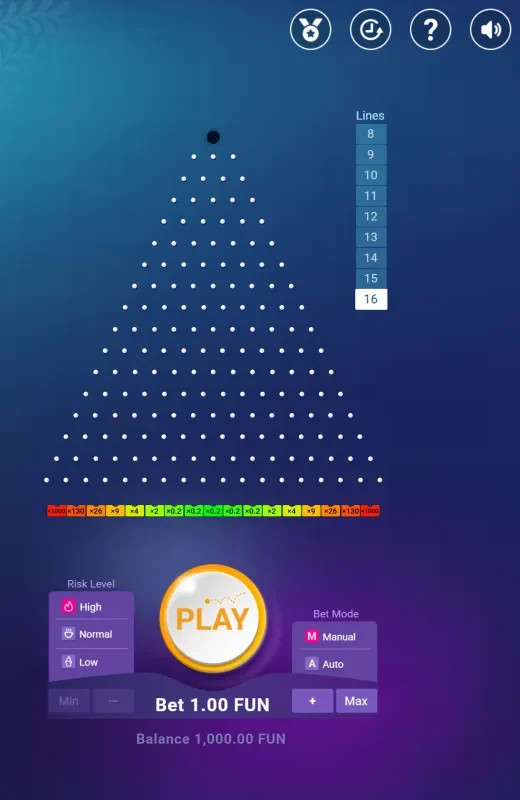
On 22 October 2026, we inspected the official BGaming public demo at 1280×800 desktop resolution and 390×844 mobile emulation. The initial interface displayed 8 lines, Low risk, 1.00 FUN per ball, and a 1,000.00 FUN virtual balance. The visible paytable showed a middle bucket of 0.5× and edge buckets of 5.6×. After selecting 16 lines and High risk through the interface, the middle bucket dropped to 0.2× and the edges rose to 1,000×.
These controls change the displayed paytable and the distribution of possible outcomes, but they do not change the amount of virtual currency you hold or guarantee any specific result. The question-mark button opened the official rules, and no session errors appeared during our inspection. However, we did not press Play, place bets, or complete any rounds. The demo uses FUN currency, which is not Canadian dollars and cannot be withdrawn.
Sources: Our official public-demo control inspection, 22 October 2026 · BGaming original Plinko product page
How to Calculate C$ Stakes and Net Returns
Our currency calculator separates three numbers that players often confuse: the stake per ball, the number of balls dropped, and the total cost of the action. If you set a C$0.20 stake per ball and drop 3 balls per action across 10 actions, your total staked is C$6.00, not C$0.20. This distinction matters because a return below 1× on a single ball creates a net loss even though money returns to your balance.
For example, with a hypothetical C$2.00 stake, a 0.2× multiplier returns C$0.40 gross, which is a net loss of C$1.60. A 0.5× return gives you C$1.00 back, a net loss of C$1.00. Only a 1× return breaks even (C$2.00 gross, C$0.00 net), and a 5× return provides C$10.00 gross, or C$8.00 net profit. The calculator requires you to input your stake, the multiplier result, and the number of balls to compute these figures explicitly.
Why Per-Ball Stake Matters More Than Total Exposure
A March 2025 forum post describes confusion between ball count and stake per ball. Its author intended many $1 drops but reported entering one much larger stake. The currency and a Canadian location were not established; this is unverified international testimony. LeoVegas’s Canadian Gaming Corps Plinko page states that the stake applies to each ball. In a Canadian-dollar arithmetic example, ten balls at C$1 cost C$10 in total.
Our separate calculator takes stake per ball and ball count to display total exposure. It does not control an operator’s game or confirm a wager. Use it to check the arithmetic, then read the actual client’s values and currency. The same numerical input can represent FUN credits in a demo and money in a funded account.
Sources: Anybody ever miskey a bet? · LeoVegas Plinko by Gaming Corps
Mobile Display Limitations and Workarounds
During our 22 October 2026 inspection, Chrome mobile emulation at 390×844 pixels revealed significant scaling issues with the BGaming demo. Portrait orientation rendered the game controls too small for comfortable use, particularly the risk and line selection buttons. This is a real limitation of the embedded demo format, not a passed physical-phone test.
If you encounter similar scaling problems on a mobile device, rotate to landscape orientation or use the provider’s own fullscreen page rather than an embedded iframe. The game pixels displayed English controls in both our desktop and mobile captures; a French-language guide does not promise that the third-party game interface itself offers French text. Check your operator’s mobile lobby to see if they provide a native app or optimized wrapper that handles scaling better than a direct browser embed.
Sources: Our official public-demo control inspection, 22 October 2026
RTP Variants and What 99% Actually Means
The BGaming original Plinko publishes a 99% RTP, but this figure represents a theoretical long-term statistical expectation across millions of rounds, not a prediction for your session. Other providers offer configurable RTP variants that operators select. Hacksaw Gaming lists variants from 88.20% to 98.98%, while 1X2gaming offers 96%, 94%, or 92%. An operator may choose a lower variant without changing the game’s display name.
A theoretical 94.30% RTP corresponds to a 5.70% house edge. If you wager C$1,000 in total turnover (not a C$1,000 deposit, but the sum of all individual bets), the mathematical expectation is a cost of C$57. However, variance means your actual session result will deviate from this average. Twenty drops at C$0.50 each cost C$10 total staked; if the sum of returns is C$8, your observed sample return is 80%, which tells you nothing about the long-run RTP.
Sources: BGaming original Plinko product page · Hacksaw Plinko · 1X2 Network Plinko GO (Branded)
Gross Return Versus Net Result
A screenshot showing a large win does not provide the complete session denominator needed to evaluate performance. In an August 2024 forum discussion, a player interpreted a string of Plinko feed entries as consecutive wins, but replies disputed whether the feed included all bets and which currency was displayed. Without knowing total staked and all losing rounds, you cannot compute whether the session was profitable.
Our accounting tool requires you to input every stake and every return to calculate a net result. For instance, 20 drops at C$0.50 each create C$10.00 total staked. If the sum of all returns is C$8.00, your net result is −C$2.00, regardless of whether one individual drop hit a 5× multiplier. A return below 1× is a net loss on that specific ball, even though money appears in your balance.
Sources: How is this even possible??
Bonus Wagering and Plinko Exclusions
Before using bonus funds, verify whether Plinko contributes to wagering requirements. The Lucky Days public bonus terms explicitly list Plinko among categories contributing 0% toward wagering requirements, meaning bets on Plinko do not clear the bonus. This is a specific counterexample to claims that all casino games contribute equally, but it is not a universal rule; other operators may treat Plinko differently.
Additionally, bonus terms often specify a maximum stake per round. If you accidentally configure a multi-ball drop where the total exposure exceeds this limit, you may violate terms even if the per-ball stake seems small. Our calculator displays total exposure prominently to help you stay within operator-imposed limits, but you must check the specific bonus terms for your offer.
Sources: Lucky Days Bonus Terms & Conditions · Won this a couple weeks ago. Just moved back home to save some money and was treated with this. 10$ Plinko drop into a 1718x.
What to Record After a Disputed Round
If a game disconnects during a result or you suspect a malfunction, specific evidence helps the support team investigate the issue. A forum thread reviewed on 22 October 2026 (exact publication date unavailable; the search result indicated it was roughly two months old) described a player experiencing disconnections during Loto-Québec slot games and difficulty supplying exact times to support. Another reply noted that checking game history revealed auto-completed rounds.
Record the game name, provider, round reference number, local time and time zone, stake amount, balance before and after, and a screenshot if possible. Check your transaction or game history before repeating a bet, as the round may have completed server-side. For Ontario-regulated sites, iGO can review unresolved disputes about its regulated products, but cannot directly settle bets or award compensation. Québec disputes follow Loto-Québec’s own process, not iGO.
Sources: Loto Quebec, weird glitches · Player Support
Casino Plinko Versus OLG and Loto-Québec Lottery
The tools on this page apply to adjustable casino pegboard games, not to OLG INSTANT PLINKO (game 3402) or Loto-Québec’s online PLINKO launched 9 June 2025. These are distinct lottery products with fixed odds and different mechanics. OLG’s version costs C$5 per play with a theoretical payout of 66.90% and overall odds of 1 in 3.80, while Loto-Québec’s online version costs C$5 with a 67% theoretical payoff and overall odds of 1 in 3.5.
Neither lottery product allows you to adjust lines, risk, or stake per ball. The OLG version involves scratching a ticket to reveal numbers, with a CHIP winner validating in-store to see an animated result, while Loto-Québec’s online version uses 20 play areas where matching a revealed number awards the shown prize. Do not use the casino version calculator to evaluate lottery tickets, and do not transfer lottery odds to casino games.
Sources: Play PLINKO In-Store · PLINKO online lottery summary and rules