
What do you need before your first Plinko drop?
You need three things: a device with a modern browser, a clear understanding of which Plinko product you are opening, and a firm decision about whether you are using virtual demo funds or real Canadian dollars. The BGaming original public demo loads without an account and uses a virtual balance labelled FUN. That balance is not CAD, cannot be withdrawn, and does not represent money you deposited. Treat it as a training tool only.
Before you press anything, confirm the game identity. Casino Plinko is an adjustable pegboard game where you control lines and risk. OLG INSTANT PLINKO is a $5 retail scratch ticket with a possible animated board event. Loto-Québec offers a separate $5 online scratch product. These are not interchangeable, and their rules, odds and payout percentages differ. This article covers the casino version only.
Check your province’s rules before considering real-money play. Ontario requires players to be 19 or older and physically located in the province for regulated iGaming. Alberta’s market is expanding, but the current AGLC iGaming page was index-readable only during our review; the live page returned a 502 error, so we cannot confirm the exact launch year. Quebec residents use Loto-Québec’s own platform, which has separate eligibility rules.
Sources: BGaming original Plinko product page · What Sites Are Regulated For Play In Ontario? · iGaming · Specific conditions of use
What is the difference between demo FUN and real CAD?
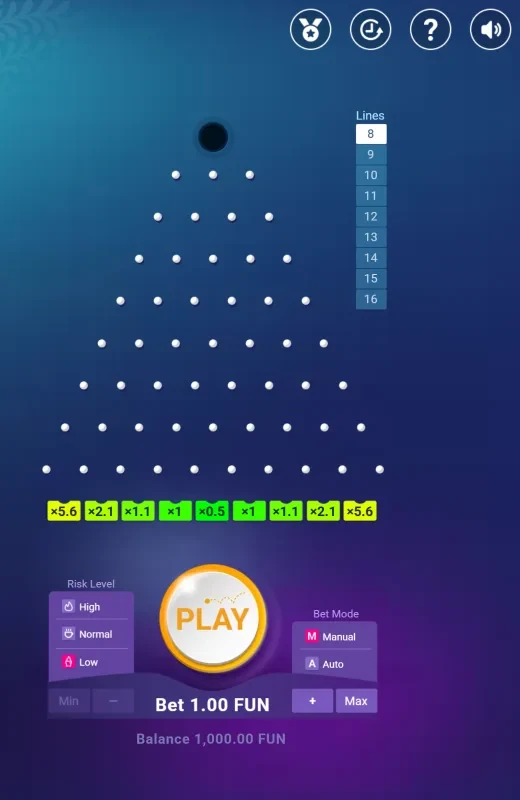
The BGaming public demo gives you 1,000.00 FUN. That number is a virtual counter, not a bank balance. You cannot cash it out, and it does not reflect any deposit. The demo exists so you can see how the paytable changes when you adjust lines and risk without financial exposure.
Real-money play requires an account with a licensed operator, identity verification, and a deposit in Canadian dollars. The operator sets the available stake range, which may differ from the demo’s default 1.00 FUN per ball. No universal Plinko account exists; each casino or lottery platform manages its own login, balance and withdrawal process.
A common misunderstanding is treating demo results as practice for winning. The demo lets you learn its controls, but its relationship to an operator’s real-money configuration was not tested. A short virtual session does not predict future real-money results. Use the demo to learn controls, not to test a system.
Sources: Our official public-demo control inspection, 22 October 2026 · LeoVegas Plinko by Gaming Corps
How do lines and risk change the board?
Lines are the number of horizontal rows the ball can bounce through. The BGaming original offers 8 to 16 lines. More lines mean more pegs and more possible paths, which spreads the ball’s final position across a wider range of buckets. Fewer lines concentrate outcomes toward the centre.
Risk is a separate setting: Low, Normal or High. Risk changes the multiplier values attached to each bucket. On Low risk with 8 lines, the demo shows a middle bucket of 0.5× and edges of 5.6×. Switch to 16 lines and High risk, and the middle drops to 0.2× while the edges rise to 1,000×. The ball still falls randomly; only the payout scale changes.
These settings interact. A 16-line High-risk board has a wide spread: many centre buckets pay less than your stake, while rare edge buckets pay large multiples. An 8-line Low-risk board clusters outcomes near the middle, with smaller multipliers and less extreme losses. Neither configuration creates a positive expectation; they only change the shape of possible results.
Sources: BGaming original Plinko product page · Our official public-demo control inspection, 22 October 2026
How does bet per ball work, and what does it cost?
Your stake applies to each ball you drop. If you set the bet to C$1 and release one ball, you stake C$1. If you release ten balls at C$1 each, you stake C$10 total. The game does not treat ten balls as a single C$1 wager; each ball is a separate bet with its own outcome.
This matters when you use any multi-ball or auto-drop feature. A player in a forum thread described intending many small drops but accidentally entering one large bet because they confused the number of balls with the stake amount. Always check the total exposure before confirming. If the screen shows C$2 per ball and 5 balls queued, your total stake is C$10.
Hypothetical example: you set C$0.50 per ball and drop 20 balls. Your total staked is C$10. If the sum of all returned amounts equals C$8, your net result is −C$2. That is an 80% observed return for that sample, not a prediction of long-run RTP. Stakes are not deposits, and returns are not withdrawals until you request a payout from the operator.
Sources: LeoVegas Plinko by Gaming Corps · Anybody ever miskey a bet?
How do you read the multiplier buckets?
Each bucket at the bottom of the board displays a multiplier: 0.2×, 0.5×, 1×, 5×, and so on. That multiplier applies to your stake for that ball. A C$2 stake landing in a 0.5× bucket returns C$1 gross, which is a net loss of C$1. A 1× bucket returns your stake exactly, net zero. Anything below 1× is a net loss.
The centre buckets typically pay less than 1×, especially on higher line counts and risk levels. The edge buckets pay the largest multipliers but are the hardest to reach. On a 16-line High-risk board, the middle bucket pays 0.2×, meaning a C$2 stake returns C$0.40, a net loss of C$1.60.
The paytable updates immediately when you change lines or risk. The demo shows this clearly: switch from 8 lines Low to 16 lines High, and the bucket values shift. This is a display change, not a change in your balance or a guarantee of any outcome. Always review the paytable after adjusting settings.
Sources: Our official public-demo control inspection, 22 October 2026 · Hacksaw Plinko
Should you use manual or auto mode first?
Manual mode drops one ball each time you press the button. This is the best way to learn because you see each stake, each path and each result individually. You can pause between drops, check the paytable, and confirm your settings before the next ball.
Auto mode queues multiple balls to drop in sequence without repeated clicks. This speeds up play but also speeds up total exposure. If you set C$1 per ball and queue 50 balls, you are staking C$50 in a short time. Auto mode does not change the odds; it only changes how quickly you place bets.
Start with manual mode until you are comfortable reading the paytable and calculating total cost. If a version offers auto mode, treat it as a faster way to accumulate exposure, not as a changed odds or recovery tool. Verify any stop-condition or loss-limit controls in that version's own rules before relying on them; we did not test auto mode in the demo. Never rely on auto mode to chase losses or recover a deficit.
Sources: Our official public-demo control inspection, 22 October 2026
How is each drop settled?
When the ball lands in a bucket, the game multiplies your stake for that ball by the bucket value and credits the result to your balance. If you staked C$2 and the ball lands in a 3.2× bucket, you receive C$6.40 gross. Your net gain is C$4.40. If the ball lands in a 0.3× bucket, you receive C$0.60 gross, a net loss of C$1.40.
We did not place a bet or time settlement in this inspection. Use the actual game history and balance record to confirm whether a particular ball has settled. If you drop multiple balls in auto mode, each one settles separately. The game does not pool your total stake and pay a single combined result; each ball is an independent event.
A return below 1× is a net loss, even though the game credits something back. This is different from a total loss, but it still reduces your balance. Over many drops, frequent sub-1× returns can add up. Track your total staked and total returned to see your real session result.
Sources: Our official public-demo control inspection, 22 October 2026
Why do most buckets pay less than your stake?
The paytable is weighted so that centre buckets, where the ball lands most often, pay less than 1×. This is how the game creates a house edge. If every bucket paid 1× or more, the operator would lose money over time. The edge buckets pay large multiples but are rare.
On a 16-line High-risk board, the middle bucket pays 0.2×. That means a C$1 stake returns C$0.20, a net loss of C$0.80. The next bucket might pay 0.5×, returning C$0.50, a net loss of C$0.50. Read the complete selected multiplier strip to identify returns above 1×. The screenshots alone do not establish the frequency of each bucket.
This structure is not hidden; the paytable is visible before you drop. The challenge is psychological: seeing a return of C$0.40 feels like a partial win, but it is still a loss. Over 20 drops at C$0.50 each, if most balls land in sub-1× buckets, your total returned will be less than your C$10 total staked.
Sources: Our official public-demo control inspection, 22 October 2026 · Hacksaw Plinko
What does a hypothetical C$10 session look like?
Imagine you set C$0.50 per ball and drop 20 balls in manual mode. Your total staked is C$10. After 20 drops, the game has credited C$8 back to your balance. Your net result is −C$2. Your observed return for this sample is 80%, calculated as C$8 returned divided by C$10 staked.
This 80% is not the game’s RTP. RTP is a long-run statistical expectation across millions of drops. A 20-drop session is a tiny sample with high variance. Another 20-drop session might return C$12, a net gain of C$2, or C$5, a net loss of C$5. Short sessions tell you nothing about the underlying probability.
If you had staked C$1 per ball instead, your total staked would be C$20. The same 80% observed return would mean C$16 back, a net loss of C$4. Doubling the stake doubles the exposure but does not change the odds. Always calculate total staked before you start, and decide in advance how much you are willing to lose.
What mistakes do new Plinko players make?
The most common mistake is confusing the number of balls with the stake per ball. A forum poster described entering a large bet when they intended many small ones. Always check both fields before confirming. If the screen shows C$5 per ball and 10 balls, your total exposure is C$50.
Another mistake is chasing losses by increasing the stake after a losing drop. This is the Martingale approach, and it does not work in Plinko. A losing sequence of C$1, C$2, C$4, C$8 and C$16 consumes C$31. The next stake would be C$32. Because many buckets pay less than 1×, even a win does not always recover the full accumulated loss.
A third mistake is treating a big win as proof of a system. A screenshot of a 1,000× hit does not show the total staked, the number of losing drops before it, or the net session result. Without a complete ledger of all stakes and returns, you cannot calculate whether the player profited. Do not copy a strategy based on a single image.
Sources: Anybody ever miskey a bet? · How is this even possible??
How is casino Plinko different from OLG or Loto-Québec Plinko?
OLG INSTANT PLINKO is a C$5 retail scratch ticket. A CHIP prize leads to an animation on the retailer’s terminal; a PLINKO prize qualifies for an event with a physical board. Loto-Québec offers a separate C$5 online scratch game. These products have different channels, rules, odds and procedures.
OLG game 3402 has a theoretical prize payout of 66.90% and overall odds of 1 in 3.80. The odds of qualifying for a live board event are 1 in 1,056,440. Loto-Québec’s online PLINKO, launched June 9, 2025, costs $5, has a theoretical payoff of 67%, and overall odds of 1 in 3.5. Grand-prize qualification odds are 1 in 1,750,000. These are separate products with different denominators.
Do not apply casino Plinko logic to lottery tickets. A scratch ticket has a fixed outcome printed at the time of purchase. The animated board is entertainment, not a skill-based drop. If you want to understand lottery Plinko, read the official OLG or Loto-Québec rules for the specific game version.
Sources: Play PLINKO In-Store · PLINKO online lottery summary and rules · PLINKO French official route and retail category
What should you do after learning the controls?
If you are comfortable with the demo and want to explore real-money play, first check whether your province offers regulated options. Ontario players can verify operator status through the iGO directory. Alberta’s market is expanding, but confirm current availability through AGLC. Quebec residents use Loto-Québec’s platform. Other provinces have their own rules; do not assume access based on a casino’s Canadian marketing page.
Before depositing, read the operator’s terms for the specific Plinko version you intend to play. Check the stake range, the RTP if published, and whether the game contributes to any bonus wagering requirement. One operator’s public bonus terms list Plinko at 0% contribution, meaning Plinko bets do not clear the bonus. This is not universal; always check the current terms for your account.
Set a loss limit and a time limit before you start. Decide the total amount you are willing to lose, and stop when you reach it. Do not chase losses or increase stakes to recover. If you feel your gambling is becoming a problem, Ontario residents can contact ConnexOntario at 1-866-531-2600. Other provinces have their own support services.
Sources: What Sites Are Regulated For Play In Ontario? · Player FAQs · Lucky Days Bonus Terms & Conditions · Find Help