
Why does the exact Plinko version matter before any comparison?
Plinko is best understood as a mechanic rather than a single product. A ball or chip falls through a field of pegs into one of several buckets, and each bucket carries a multiplier or prize. Beyond that shared skeleton, almost everything can differ: the number of rows, the risk setting, the published return-to-player percentage, the maximum multiplier, and even whether the board decides anything at all. Two games sitting side by side in one casino lobby can both be called Plinko while resting on entirely different mathematics.
The practical consequence is that the loudest number in any marketing tile, usually the maximum multiplier, is meaningless until you know which edition it belongs to. A 1,000× cap on one provider's game and a 3,843.3× cap on another's tell you nothing about which is 'better', because the probability of reaching those extremes, the RTP variant actually configured, and the stake limits all sit behind the headline. The first question is never 'which Plinko pays most' but 'which Plinko am I actually looking at'.
Version identification is also a safety habit. Lottery Plinko in Ontario and Québec is a $5 ticket product with fixed published odds, casino Plinko is a configurable stake game, and reward apps using the name are something else entirely. Treating one category's rules as if they applied to another leads to real misunderstandings about cost, odds and what a win means.
Sources: Play PLINKO In-Store · PLINKO online lottery summary and rules · LeoVegas Plinko by Gaming Corps
What is the BGaming original Plinko and what is actually verified about it?
BGaming publishes an original Plinko edition with an official public demo. Its product page lists 99% RTP, a 1,000× maximum, eight to sixteen lines and Low, Normal and High risk settings. These are specifications for that named supplier product. They do not establish how often Canadians encounter it or which configuration a particular operator uses.
Our own inspection of the official public demo on 22 October 2026 shows what those settings mean on screen. The interface opened at 8 lines, Low risk and 1.00 FUN per ball against a 1,000.00 FUN virtual balance, with the middle bucket showing 0.5× and the edge showing 5.6×. After selecting 16 lines and High risk through the normal controls, the displayed paytable changed: the middle bucket dropped to 0.2× and the edges rose to 1,000×. Changing risk or lines changes the paytable you face, not your balance and not any guarantee.
Two cautions belong here. First, the demo runs in FUN currency, which is not Canadian dollars and cannot be withdrawn; it is a learning tool, not a funded session. Second, BGaming's own marketing has at times gestured toward lucky times or tracking past results, and none of that should be endorsed: each drop is independent, and a provider specification sheet is not a strategy.
A note on Plinko 2: BGaming has been associated with a follow-up edition, but this guide does not have verified specification data for it, so no rows, RTP or maximum figures are claimed here. If you encounter it in a lobby, open its in-game help and treat it as a separate product rather than assuming it inherits the original's 99% and 1,000× profile.
Sources: BGaming original Plinko product page · Our official public-demo control inspection, 22 October 2026
How do Hacksaw Plinko and 1X2gaming Plinko GO differ on paper?
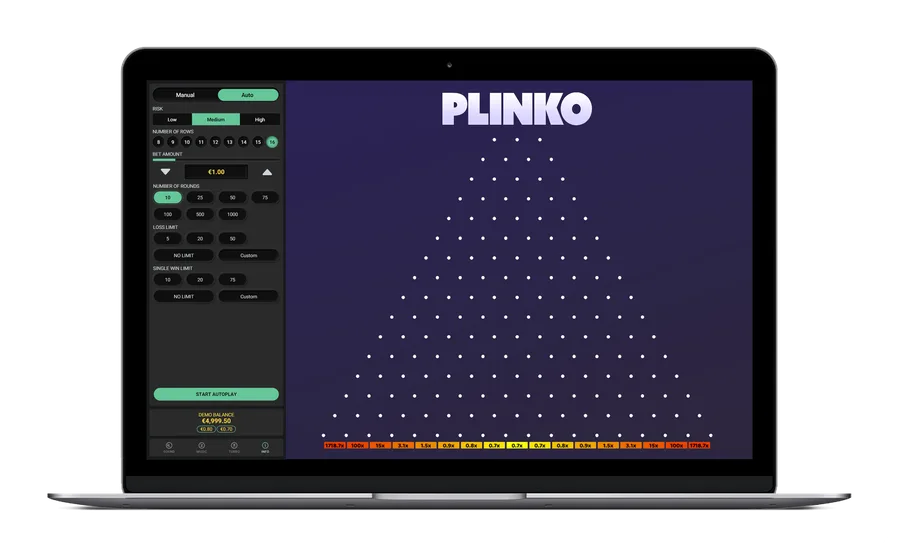
Hacksaw Gaming's Plinko publishes 8 to 16 rows and low, medium and high risk settings, with a listed maximum multiplier of 3,843.3×. The most important detail is its RTP list: 98.98%, 98.28%, 97.27%, 96.02%, 94.30%, 92.03% and 88.20%. That is a range of more than ten percentage points, and the highest variant is not automatically the one an operator selects. The same Hacksaw tile at two different casinos can therefore represent materially different long-run costs.
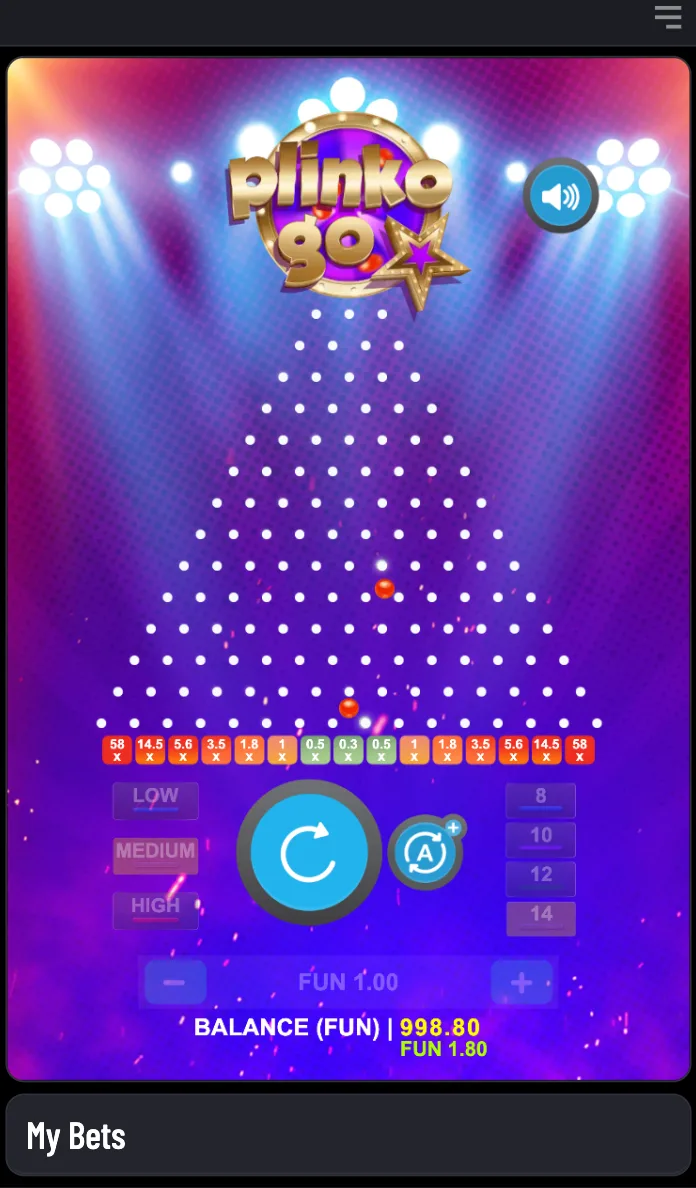
1X2gaming's Plinko GO, listed through 1X2 Network as a branded title, publishes RTP variants of 96%, 94% and 92%, a maximum of 420×, and a listed stake range of 0.10 to 50.0 without a currency label, alongside configurable board size and risk. The lower ceiling compared with Hacksaw does not make it worse or better in isolation; it simply defines a different shape of outcomes, with less of the paytable concentrated in an extreme edge bucket.
The shared lesson is that 'RTP variants' means the operator chooses a setting from a menu the provider supplies. A player comparing games should look for the RTP stated in the in-game help or info panel of the exact instance they are playing, because the provider's headline figure and the deployed figure can legitimately differ. Neither provider's page proves what a local operator has configured.
Sources: Hacksaw Plinko · 1X2 Network Plinko GO (Branded)
Why doesn't a casino catalogue listing prove the rules or configuration?
A catalogue tile is evidence that a name appears on a page, nothing more. Our Ontario research illustrates the gap clearly: the indexed LeoVegas Ontario catalogue lists Pine of Plinko 2 and Pond of Plinko by Print Studios plus Triple Pot Plinko - Hercules by Pragmatic Play, all Plinko-themed slot hybrids rather than adjustable pegboard games. Meanwhile a plain LeoVegas Plinko by Gaming Corps appears on the operator's /en-ca Canadian page, but its guessed Ontario-equivalent route returned a 404, so no Ontario availability claim is supported for that title.
Lucky Days shows the same problem from another angle. An indexed Ontario Plinko category exists and displays eight games with provider labels including Print Studios, Hacksaw Gaming, Evolution, Pragmatic Play and Coin Machine Gaming, but the extraction omitted individual game names and the live page returned a 403 to our ordinary request. A category with provider labels cannot prove which edition is offered, and it certainly cannot prove that a specific well-known version such as SPRIBE's or Stake's is present.
The reliable sequence is: confirm the operator is regulated for your province through the official directory, open the actual lobby, launch the game's info or help panel, and read the RTP, rows and paytable stated there. Directory status verifies the operator, not the title; a tile verifies a name, not the mathematics. Each layer answers a different question, and skipping one leaves you guessing.
Sources: Ontario Online Slots · LeoVegas Plinko by Gaming Corps · Plinko in Ontario · What Sites Are Regulated For Play In Ontario?
Are Plinko Gold, Plinko GO and Plinko apps the same game?
No, and the naming overlap causes real confusion. Plinko GO is a specific branded title from 1X2gaming with the published figures described above. 'Plinko Gold' appears in Canadian searches, but this review found no verified provider identity behind that exact name; it may be a marketing label, a regional skin, or a misremembered title, and it would be wrong to invent a specification for it. If you meet it in a lobby, the in-game help panel is an important source of its rows, RTP and maximum.
Gaming Corps supplies another branch of the family. Its Plinko Slam Dunk, released in November 2025, lists RTP configurations of 97%, 94% and 92% and a maximum of 5,000× with basketball-themed multiplier boosts and lanes. Those figures belong to Slam Dunk alone and must not be transferred to the Gaming Corps game listed as LeoVegas Plinko, which is a separate product described on the operator's Canadian page with 8, 10, 12, 14 or 16 rows, batches of 1, 2, 3, 5 or 10 balls, and low, medium and high risk.
Apps are a third category entirely. A reward app using the Plinko name is typically an advertising-funded points product, not a licensed casino game, and an app-store listing is not a gambling licence. There is no universal Plinko account, login, withdrawal system or free-spins code spanning these products; each casino game belongs to its operator account, each lottery product to its provincial corporation, and each app to its own developer.
Sources: 1X2 Network Plinko GO (Branded) · Plinko Slam Dunk · LeoVegas Plinko by Gaming Corps
How do OLG and Loto-Québec Plinko differ from casino Plinko?
Provincial lottery Plinko is a fixed-odds ticket product, not an adjustable stake game. OLG's INSTANT PLINKO, game 3402, costs $5 per play, publishes a theoretical prize payout of 66.90% and overall odds of 1 in 3.80. Scratching matches numbers for instant prizes; a CHIP symbol validates in store for an animated result, and a PLINKO qualifier leads to a live board event with prizes from $100,000 to $500,000. The odds of qualifying for that event are 1 in 1,056,440.
Loto-Québec's online PLINKO, launched 9 June 2025, also costs $5 but publishes a theoretical payoff of 67% and overall approximate odds of 1 in 3.5, with grand-prize qualification at 1 in 1,750,000 and the same $100,000 to $500,000 event prize range, held at Casino de Montréal. Crucially, its rules state the CHIP board animation is entertainment and does not determine the chances of winning, and that player choices and skill do not alter the outcome. Loto-Québec also lists a separate $5 retail scratch Plinko, whose odds must not be borrowed from the online issue.
These figures sit in a completely different framework from casino Plinko. A lottery ticket's payout percentage is a launch calculation across the whole printed or issued pool, assuming all relevant tickets are sold and prizes claimed; it is not a configurable RTP and not an individual's expected return. Pooling OLG and Loto-Québec numbers, or comparing either directly with BGaming's 99%, mixes products that share nothing but a pegboard.
Sources: Play PLINKO In-Store · PLINKO online lottery summary and rules · PLINKO French official route and retail category
What do rows and risk settings actually change across versions?
The BGaming captures show the difference visually: eight lines/Low displayed 0.5× in the centre and 5.6× at the edges; sixteen lines/High displayed 0.2× in the centre and 1,000× at the edges. Both lines and risk changed, so the images do not isolate either control’s effect. The multiplier strip does not establish the frequency of each result or identical RTP across settings. Check the selected edition’s help and probability information.
A return below 1× is a net loss on that ball. For a hypothetical C$2 stake, 0.2× returns C$0.40 for −C$1.60 net; 0.5× returns C$1 for −C$1 net; 5× returns C$10 for +C$8 net. The size of a return and its probability are separate information. A large multiplier alone cannot establish expected return.
Sources: Our official public-demo control inspection, 22 October 2026 · BGaming original Plinko product page
How should you read a paytable and RTP before staking real money?
Start with the in-game help or info panel, not the lobby tile and not a review site. The panel should state the RTP for the deployed configuration, the multiplier attached to each bucket at your chosen rows and risk, and the stake rules. Write down or screenshot the RTP figure, because with providers like Hacksaw offering seven variants, the number in front of you is the only one that matters to your session.
Translate RTP into cost terms before playing. A theoretical 94.30% RTP implies a 5.70% house edge, which is an expected cost of about C$57 per C$1,000 of total turnover across mathematical expectation. Turnover is the sum of every stake, not your deposit: twenty drops at C$0.50 is C$10 staked, and a C$100 deposit cycled repeatedly can reach C$1,000 of turnover faster than intuition suggests. No individual session is predicted by this figure; it is a long-run average.
Keep gross and net separate in your own accounting. If you stake C$10 across twenty drops and the returns sum to C$8, your observed sample return is 80% and your net is −C$2, regardless of which individual buckets hit. A screenshot of one large multiplier says nothing about the session denominator, which is why public win clips prove neither a strategy nor a fault.
Sources: Hacksaw Plinko
What about physical Plinko boards, Costco and DIY versions?
Some saved Canadian search suggestions concern a physical product: a giant board for a party, a classroom probability demonstration, a wedding game, or a retail purchase such as the Costco queries that appear in autocomplete. This guide covers digital casino games and provincial lottery products only. We cannot verify retailer stock, current prices, or product quality, and we make no retail recommendations.
The intent boundary matters because the products answer different questions. A physical board is a one-time purchase for entertainment or teaching, with no RTP, no stake and no payout structure; a casino or lottery Plinko is a regulated gambling product with published mathematics and real money at risk. Advice about one is useless for the other, and a retailer listing tells you nothing about game rules.
For home or classroom use, a simple fair board is genuinely instructive: with independent left-right bounces across n rows, the probability of landing in position k follows the binomial pattern choose(n,k) divided by 2^n, which is why chips pile up in the centre. That teaching model is explicitly not the certified mathematics of any commercial Plinko, whose weighting is set by the provider or lottery. If your goal is a party board, a hardware store and a sheet of pegboard will serve you better than any page on this site.
What is the right checklist before comparing two Plinko games?
Work through five questions in order. First, category: is this a casino pegboard, a slot hybrid, a lottery ticket or an app? Second, identity: which provider and exact edition, confirmed in the game itself rather than the tile? Third, configuration: what RTP variant, rows and risk settings does the in-game panel state? Fourth, cost: what is the stake per ball or ticket, and what does a full action cost in Canadian dollars? Fifth, context: is the operator regulated for your province, and do bonus terms treat this game the way you assume?
The bonus question deserves emphasis because it is where version confusion gets expensive. Lucky Days' public bonus terms list Plinko among categories contributing 0% toward the described wagering requirement on that particular non-Ontario offer. That is one operator's document, not a universal rule, but it is a verified counterexample to any assumption that Plinko bets clear bonuses. Check the eligible-games and contribution list of the exact offer in front of you before staking.
Once those five answers are written down, comparison becomes honest. You can weigh BGaming's 99% and 1,000× profile against Hacksaw's configurable range and 3,843.3× ceiling, or decide that a $5 OLG ticket's fixed 1-in-3.80 overall odds suit you better than any adjustable game, because you are finally comparing identified products on stated terms rather than marketing headlines.
Sources: Lucky Days Bonus Terms & Conditions · BGaming original Plinko product page · Hacksaw Plinko · Play PLINKO In-Store